Cost · Los Angeles, CA
Wolf Range Repair Cost: All Six Price Bands
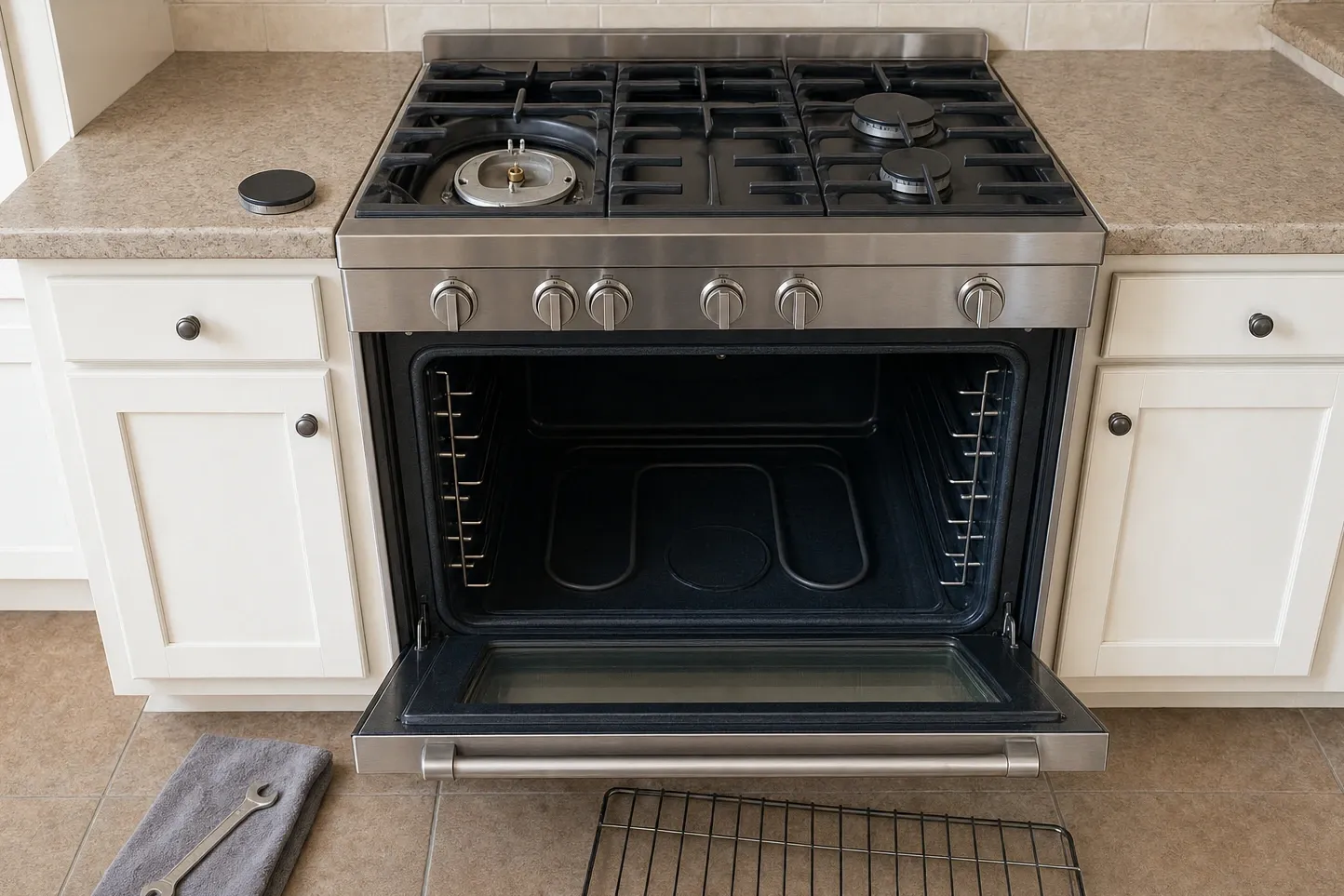
A range is two appliances sharing a fascia, so the first question is which half is broken. Burner side, and you are in one of the first two bands. Oven side, and you are in one of the other four. The $89 visit is what settles which, and it comes off whatever follows.
| Band | Where it turns up | Installed |
|---|---|---|
| Igniter or spark module | Electrodes, spark modules, leads and the oven igniter | $170–$470 |
| Burner valve or orifice service | Burner valves, orifices and the simmer setting behind them | $270–$630 |
| Oven thermostat or sensor calibration | Temperature sensors, thermostats and calibration | $190–$470 |
| Convection fan or motor | Convection motors and cavity cooling fans | $260–$690 |
| Control board or touch panel | Relay and control boards, touch panels, switch banks | $450–$930 |
| Door hinge, glass or seal | Hinges, door glass and the seal round the cavity | $280–$740 |
| Service call | Every visit, before anything is opened | $89 |
The point where replacing wins
| What is in front of you | Figure |
|---|---|
| The cheapest band on this page | $170–$470 |
| The dearest band on this page | $450–$930 |
| The visit that decides which one | $89 |
| Buying new instead | $8,340–$18,770 |
That last line buys a comparable professional range, before installation and ventilation work. Two bands stacked on one machine still sit a long way under it, which is why almost everything on this page is worth repairing — and why the rare case that is not gets said out loud on the visit rather than quoted round.
Which half is broken
Burner side and oven side fail for unrelated reasons, and almost nobody arrives knowing which they have. Work down this list before you look at a figure.
- Sparking with no flame, a flame that lifts off the cap, or no low end on the dial — that is the cooktop, and it is the first two bands.
- A cavity that is cool, slow, or wrong by a steady margin — sensors and calibration, the third band.
- A fan that screeches, stops mid-roast, or never runs at all — the fourth.
- A panel that ignores you, resets itself, or goes dark — the fifth, and the one most often blamed when the fault is elsewhere.
- A door that will not close square, cracked glass, or heat escaping along the top edge — the sixth.
Why the cooktop bands are the cheap ones
Everything on the burner side is small, standard hardware sitting in the open once the cap and head come off: electrodes, leads, orifices, valve stems and the low setting behind the knob. The labour is careful rather than long, and almost none of it involves taking the appliance out of the cabinetry.
The oven side is the opposite. A sensor is a cheap part at the end of an awkward reach; a convection motor means the rear cover off and the cavity emptied; a control board means the fascia apart. The parts are not what moves the figure — the hour it takes to arrive at them is.
What we will not do to a range
Fit a part to see whether it helps. A steady offset and a weak bake element look identical from the front panel and land in two different bands, so the probe goes on the rack before anything is ordered.
Follow-ups
Why is every line a range rather than one price?
Because two kitchens with the same symptom rarely need the same part. The low end of a band is a switch, a sensor or an igniter; the high end is a board or a full burner assembly with the labour to reach it. The exact figure for your range is agreed with you on site before anything is opened.
Can two bands apply to one repair?
They can, and it is common on a range that has been left running with a known fault. A dead oven igniter and a drifting sensor are separate jobs in separate bands. You are told both figures, and you decide whether to do one, both, or neither on the day.
Does the service call really come off the repair?
Yes, in full, the moment you approve the work. Wolf Appliance Repair Los Angeles charges $89 for the visit and the whole diagnosis, and if you go ahead that $89 is deducted from the repair. Ring (310) 878-0630 and it is the same on every job on this page.
Reviews
What owners said after the invoice
One fault, what it turned out to be, what it came to.
4.9/ 51,475 reviews
Pancakes browned on one side of the griddle and stayed raw on the other. The thermostat probe under the plate had drifted badly. He swapped it, then ran a butter test across the surface to prove it was even.
Darius M.
Marine air had eaten the igniter hardware on the two burners nearest the window, so they sparked but never caught. He fitted new ones, sealed the box properly, and showed me the green corrosion he pulled out.
Bertie H.
The charbroiler would light and then drop out after ten minutes, every time. A tired flame sensor and a burner that had shifted off its bracket. Working since. Took two visits because the first slot was rained out.
Arcelia V.
Two ways in, and nothing to fill out
Say what the machine is doing, and the fault gets named
Have the model number to hand if you can, or just the letters at the front of it — DF, GR, SRT, CG, CI, SO, DO, PW. Those say what you own, and what you own decides which parts travel out with the technician.
$89 service call, flat, credited against an approved repair · line answered 24/7